Visiting Maru Koala and Animal Park
Maru Koala and Animal Park is a small wildlife park near Melbourne best known for hands-on encounters with koalas, kangaroos, wallabies, and other native Australian animals. The experience is relaxed rather than overwhelming, but it rewards timing more than people expect — arrive early and the kangaroo feeding areas, keeper talks, and mini-golf all feel easier to enjoy. The biggest mistake is treating it like a quick roadside stop when 2–4 hours gives you a much better visit. This guide covers timing, tickets, layout, and what to prioritize first.
Quick overview: Maru Koala and Animal Park at a glance
If you want the short version before you book, this is what actually changes the day.
- When to visit: Daily, 9:30am–5:30pm. 9:30am–10:30am is noticeably calmer than 11am–2pm, and the kangaroos are usually more interested in feeding before the park settles into its midday rhythm.
- Getting in: From A$33 for standard adult entry, with animal encounter add-ons from A$35 and the Koala Feeding Experience from A$75. You can often visit on the day for general entry, but encounter slots are limited and are worth booking ahead on weekends and school holidays.
- How long to allow: 2–3 hours suits most visitors. Add mini-golf, lunch, and one or two keeper talks, and it easily stretches to 3–4 hours.
- What most people miss: The albino kangaroos, the Tasmanian devil and dingo presentations, and the fact that Pirate Pete’s 18-hole mini-golf is part of the day rather than an afterthought.
- Is a guide worth it? Not for the basic visit, because the park is compact and easy to self-navigate, but a keeper-led encounter is worth it if you want more than quick photos and feeding time.
🎟️ Encounter slots for Maru Koala and Animal Park can sell out ahead of weekends and school holidays. Lock in your visit before the time you want is gone. See ticket options
Jump to what you need
🕒 Where and when to go
🗓️ How much time do you need?
🎟️ Which ticket is right for you?
🗺️ Getting around
🦘 Which animals to prioritise
♿ Facilities and accessibility
Where and when to go
How do you get to Maru Koala and Animal Park?
Maru sits on the Bass Highway in Grantville, around 1–1.5 hours from central Melbourne and about 15 minutes from Phillip Island, so it works best as a self-drive stop or day trip.
1650 Bass Highway, Grantville VIC 3984, Australia
→ Open in Google Maps
- Car: Bass Highway → on-site entrance → the easiest option by far, with ample free parking right at the park.
- V/Line coach: Grantville stop → short local walk or taxi connection → workable if you do not drive, but much slower than coming by car.
- Phillip Island by car: Cowes/Bass Coast route → about 15 minutes → ideal if you are pairing Maru with Penguin Parade or other island stops.
Full getting there guide
Getting here from nearby cities
Maru works well for visitors basing themselves in Melbourne or on Phillip Island, because both give you a straightforward same-day visit with time left for other stops.
From Melbourne
- Distance: About 90km
- Travel time: About 1.5 hours via the M1 and Bass Highway
- Time to budget: This still leaves enough time for a relaxed 2–4 hour visit and a same-day return
From Phillip Island
- Distance: About 15km
- Travel time: About 15 minutes by car
- Time to budget: Easy to pair with the Koala Conservation Reserve or an evening Penguin Parade plan
From Dandenong
- Distance: About 65km
- Travel time: About 2.5–3 hours via V/Line coach
- Time to budget: Best only if you are not driving, because public transport cuts heavily into your time on site
Which entrance should you use?
There is one main public entrance off the Bass Highway, and the most common mistake is overcomplicating arrival when this is a simple walk-in park rather than a multi-gate attraction.
- Main entrance: Located by the main parking area and check-in desk. Best for all visitors. Expect 0–10 minutes wait on most days, with slightly slower entry on weekend and school-holiday mornings.
Full entrances guide
When is Maru Koala and Animal Park open?
- Monday–Sunday: 9:30am–5:30pm
- Christmas Day: Closed
- Last entry: 4:30pm
When is it busiest? Weekends, Victorian school holidays, and the 11am–2pm window feel busiest, when families cluster around feeding areas, keeper talks, and lunch.
When should you actually go? Arrive close to 9:30am if you want the calmest feeding time, easier parking, and a better chance of seeing kangaroos active before the middle of the day.
Your guide to the Maru koala & animal park tickets
Which Maru Koala and Animal Park ticket is best for you
| Ticket type | What's included | Best for | Price range |
|---|---|---|---|
General Admission Ticket | Park entry + animal exhibits + Pirate Pete’s Adventure Mini-Golf | A flexible half-day visit where you want to feed kangaroos, see the core animals, and decide your pace once you arrive | From AU$33 |
Pirate Pete’s Mini-Golf Only | 18-hole mini-golf course + equipment | A quick stop where the golf matters more than the animal park | From AU$20 |
Meet a Koala | Keeper-led koala interaction + close-up photo opportunity | A short add-on when general entry feels too basic and you want one memorable animal moment without booking the full feeding experience | From AU$35 |
Koala Feeding Experience | Keeper talk + fresh gum leaves + koala feeding session | A visit where the koala encounter is the main event and you want more context than a standard walk-through gives you | From AU$75 |
Dingo / specialty animal encounters | Keeper-led encounter + supervised close-up interaction | A return visit or wildlife-focused day where you want a rarer experience than the usual kangaroo-and-koala route | From AU$55 |
How do you get around Maru Koala and Animal Park?
Park layout and suggested route
Maru is a compact, zone-based wildlife park rather than a large zoo, so you can cover the basics quickly, but presentations, feeding stops, and mini-golf are what turn it into a longer visit. The layout is easy to self-navigate, though it helps to do the animal feeding areas first while they are quieter and more active.
- Kangaroo and wallaby feeding area: Free-roaming roos and wallabies + pellet feeding + 30–45 minutes
- Koala and native animal enclosures: Koalas, wombats, and smaller native species + keeper talks nearby + 20–30 minutes
- Predator and reptile area: Tasmanian devils, dingoes, and reptile presentations + 20–30 minutes
- Pirate Pete’s mini-golf and café zone: 18-hole course + Homestead Bistro + rest stop + 60–90 minutes
Suggested route: Start with the kangaroo feeding area, then move to koalas and keeper talks before lunch, because that front-loads the most active animal interactions and keeps mini-golf for the quieter afternoon stretch.
Maps and navigation tools
- Map: Printed park map and daily schedule → animal areas, talks, and encounter times → pick it up at the entrance before you start walking.
- Signage: Wayfinding is generally simple because the park is compact, but the daily talk schedule matters enough that you should not rely on signs alone.
- Audio guide / app: None is central to the visit → the keeper talks do more of the explaining here than any self-guided app would.
- Large outdoor POIs only: Not needed here → this is a small park, so a printed map is enough for most visits.
💡 Pro tip: Grab the schedule when you enter and work backward from the keeper talks you care about most — otherwise it is easy to spend too long feeding kangaroos and miss the Tasmanian devil or reptile sessions.
Get the Maru Koala and Animal Park map / audio guide
Which animals and habitats should you prioritise?

Koala encounter area
Species: Koala
This is the signature stop, and it is where the park feels most distinct from a standard petting zoo. The real value is not just the photo — it is the keeper context around feeding, eucalyptus, and why koalas spend so much of the day resting. What most visitors rush past is the talk before or during the feeding session, which adds far more than a quick glance at a sleepy koala.
Where to find it: In the main animal section, near the keeper-led encounter area and presentation spaces
Kangaroo and wallaby feeding yard
Species: Kangaroo and wallaby
This is the part of Maru that can easily take longer than you planned, because the animals come right up for pellets and interaction. It is especially good for families, but adults usually spend longer here than expected too. What people often miss is that early morning is the best window — later in the day, the feeding yard is busier and the animals are less focused on food.
Where to find it: In the walk-through feeding area close to the café side of the park
Albino kangaroos
Species: Eastern grey kangaroo variant
These stand out because they are unusual enough to feel like a surprise even if you came mainly for the koalas. They also make one of the most memorable photo stops in the park, especially if you are traveling with children. What many visitors miss is that they are easiest to spot when you slow down in the broader kangaroo area rather than stopping only at the first animals that approach you.
Where to find it: Within the larger kangaroo and wallaby feeding zones
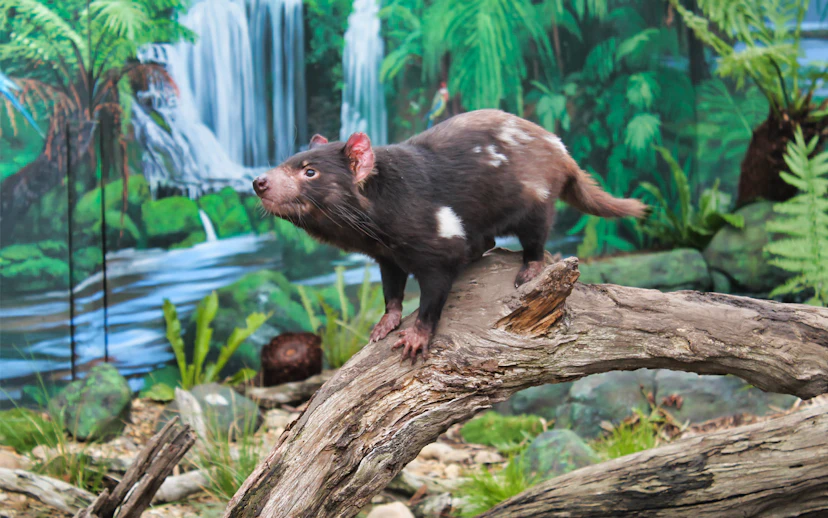
Tasmanian devils
Species: Tasmanian devil
This is one of the best reasons to look beyond the obvious headline animals. Tasmanian devils are much rarer in mainland wildlife attractions, and seeing them with keeper interpretation makes the visit feel broader than just a kangaroo feed-and-photo stop. What people often miss is the scheduled feeding or talk, which is when the devils are at their most active and easiest to understand.
Where to find it: In the native predator section of the park, near other keeper-presentation enclosures
Dingo encounter area
Species: Dingo
The dingoes add a different mood to the visit because they feel less familiar and more like a close-up look at Australia’s wild canids. Even if you do not book the separate encounter, it is worth timing your route to catch their keeper session. What many visitors miss is that the supervised feeding element is the interesting part — not just viewing the enclosure from a distance.
Where to find it: In the predator section, close to the Tasmanian devil area and scheduled talks
Facilities and accessibility
- 🎒 Day bags: Small bags are the easiest fit here because you move between outdoor enclosures, feeding areas, and mini-golf rather than storing items in one place.
- 🍽️ Homestead Bistro: The main on-site food stop serves lunch, snacks, coffee, and drinks, and it is useful enough that most families do not need to leave the park to eat.
- 🍦 Ice Bar: This is the quick snack stop for ice-cream, milkshakes, and an easy sugar break between animal areas and mini-golf.
- 🛍️ Gift shop / merchandise: There is an on-site gift shop near the main visitor area, which works best for simple souvenirs before you leave.
- 🪑 Seating / rest areas: The Homestead Bistro porch is the main sit-down rest spot, with views over the feeding area.
- 🅿️ Parking: Parking is on-site, free, and the easiest way to arrive, which matters because public transport options are limited.
- ♿ Mobility: The park is wheelchair-friendly and stroller-friendly overall, with a compact layout that is easier to manage than a large zoo, though some outdoor surfaces may still feel less even than an indoor attraction.
- 👁️ Visual impairments: The site is small enough to orient yourself quickly, and the printed map plus keeper talks are more useful here than complex route-planning.
- 🧠 Cognitive and sensory needs: Early morning is the easiest low-crowd window, while midday keeper talks, feeding zones, and the café area are the liveliest parts of the park.
- 👨👩👧 Families and strollers: Families generally find the full route manageable with a stroller, and the compact layout helps if you need to move between animal stops, food, and mini-golf without much backtracking.
Maru works well for younger children because the visit is interactive, outdoors, and short enough to hold attention, especially if you mix feeding time with mini-golf rather than doing the whole park in one pass.
- 🕐 Time: Around 2–3 hours is realistic with children, or closer to 3–4 hours if you add mini-golf, lunch, and a keeper talk.
- 🏠 Facilities: The café, snack stop, parking, and compact layout make it easier than a large zoo for families managing breaks and short attention spans.
- 💡 Engagement: Buy the kangaroo pellets early, because having a simple feeding task keeps children focused and makes the first half of the visit feel much more hands-on.
- 🎒 Logistics: Bring sunscreen, hats, and a small bag, and aim for the first hour after opening if you want calmer animal feeding and less waiting around lunch.
- 📍 After your visit: Phillip Island attractions, especially the Penguin Parade or Koala Conservation Reserve, are the easiest same-day family add-ons.
Rules and restrictions
What you need to know before you go
- Entry requirement: General entry is valid during opening hours, while keeper-led animal encounters use separate booked time slots and are worth securing ahead on busy dates.
- Booking method: Online booking is available, and if you prepaid, bring your confirmation because some visitors report being asked to show the payment card used at check-in.
- Re-entry policy: Plan to stay through lunch or mini-golf once you are inside, because the day works best as one continuous visit rather than a stop-and-return outing.
Not allowed
- 🚫 Animal feeding: Only feed the animals the approved food sold on-site, because the interactive feeding areas are managed around specific animal diets.
- 🖐️ Entering enclosures: Do not step into animal spaces unless staff invite you during a supervised encounter, because keeper-led sessions control where close contact happens.
- 🐾 Handling animals: Do not touch animals unless the interaction is clearly permitted, because some contact is part of paid or supervised experiences only.
Photography
General photography is a big part of the visit, especially around the kangaroo feeding areas, koalas, and Pirate Pete’s mini-golf. The one distinction to know is that close-up koala photo moments are tied to specific paid experiences rather than standard admission alone. Around keeper talks and animal interactions, keep a respectful distance and follow staff instructions so photography does not interrupt the session.
Good to know
- Mini-golf inclusion: General admission already includes Pirate Pete’s mini-golf, so you do not need to budget separately unless you are buying golf-only access.
- Presentation timing: Keeper talks matter more than the map here, because missing one can make the visit feel shorter and less interactive than it really is.
Practical tips
- Booking and arrival: Book animal encounters before you arrive if that is the real reason for your visit, because general entry is flexible but keeper-led slots are the part most likely to feel limited on weekends and school holidays.
- Pacing: Do the kangaroo feeding area first, then work around the keeper talks you care about most, because it is easy to lose 45 minutes there and suddenly realize you have missed the dingo or Tasmanian devil session.
- Crowd management: The best time to visit is the first hour after 9:30am, not because the whole park is huge, but because that is when the feeding areas feel least crowded and the mini-golf course is still empty for later.
- What to bring or leave behind: Bring sunscreen, a hat, and a small bag you can comfortably carry through the enclosures and mini-golf course, because this is an outdoor visit with plenty of stop-and-start movement.
- Food and drink: Either eat early before 12 noon or wait until after 1pm, because the Homestead Bistro is most convenient in the middle of the day but also feels busiest then.
- Value for money: If the ticket price feels steep to you, make sure you stay for at least one keeper talk and the included mini-golf, because a quick 45-minute walk-through is when the visit feels least worthwhile.
What else is worth visiting nearby?
Commonly Paired: Phillip Island Penguin Parade
Distance: About 20km — about 15 min drive
Why people combine them: Maru fills the daytime slot well, and the Penguin Parade gives you a natural evening finish without doubling up on the same kind of wildlife experience.
Book / Learn more
Commonly Paired: Koala Conservation Reserve
Distance: About 20km — about 15 min drive
Why people combine them: This pairing works if you want a stronger koala focus, because Maru gives you close interaction while the reserve adds elevated boardwalk viewing in a more natural bush setting.
Book / Learn more
Also Nearby
Phillip Island Wildlife Park
Distance: About 25km — about 20 min drive
Worth knowing: It is the stronger choice if you want a larger wildlife park after Maru’s smaller, more hands-on format.
Wonthaggi Wind Farm Lookout
Distance: About 25km — about 25 min drive
Worth knowing: This is an easy scenic stop if you want coastal views and a break from animal attractions on the same drive.
Eat, shop and stay near Maru Koala and Animal Park
- On-site: Homestead Bistro serves lunch, coffee, snacks, and drinks, and it is worth using because leaving for food usually breaks the flow of the visit more than it helps.
- Ice Bar: Best for a quick milkshake, ice-cream, or snack stop when you want to keep moving between the animals and mini-golf.
- Homestead Bistro porch: Best for a slower sit-down break because it overlooks the park and lets you reset without losing time driving elsewhere.
- 💡 Pro tip: If you want the easiest meal break, aim before 12 noon or after 1pm — the food is convenient, but the lunch rush is the least relaxed part of the day.
- Maru gift shop: This is the practical souvenir stop on-site for simple wildlife-themed keepsakes before you leave the park.
- Park merchandise area: It works best as an end-of-visit stop, because you do not want to carry extras while moving between feeding areas and mini-golf.
Grantville is convenient for a short stopover if Maru is only one part of a Bass Coast or Phillip Island day trip, but it is not the most appealing base for a longer Melbourne-area stay. The real advantage is reducing driving if you want an easy wildlife stop before or after Phillip Island. For most travelers, it is better as a passing stop than a destination neighborhood.
- Price point: The area is usually more practical than central Melbourne, but the bigger range of stays and dining sits closer to Phillip Island.
- Best for: Travelers doing a self-drive Bass Coast route who want simple logistics and a short drive to the park.
- Consider instead: Phillip Island or Cowes make better bases if you want more dining, evening activities, and easy access to the Penguin Parade as well as Maru.
Frequently asked questions about visiting Maru Koala and Animal Park
Most visits take 2–3 hours, though 3–4 hours is more realistic if you add mini-golf, lunch, and a keeper-led encounter. The park itself is compact, so the extra time usually comes from feeding kangaroos, waiting for scheduled talks, and staying longer at Pirate Pete’s than you planned.
You usually do not need to pre-book standard entry far in advance, but it is smart on weekends and school holidays. The bigger reason to book ahead is for keeper-led encounters like the Koala Feeding Experience, because those use limited time slots and are the part of the visit most likely to feel constrained.
Arrive close to opening at 9:30am if you want the smoothest visit, even though general admission is flexible. That first hour is the best window for calmer feeding areas, easier parking, and a better chance of seeing the kangaroos active before the middle of the day gets busier.
Yes, a small day bag makes sense for this visit. Pack light, because you will be moving between outdoor animal areas, feeding stops, and mini-golf rather than storing things in one place, and a bulky bag is more awkward than useful at a compact park like this.
Yes, photography is a major part of the visit, especially around the kangaroo feeding areas and koala section. The one thing to know is that close-up koala photo moments are tied more closely to the separate encounter products than to basic admission, so do not assume every animal photo setup is included automatically.
Yes, Pirate Pete’s 18-hole mini-golf is included with general admission. That is worth knowing before you buy, because some visitors assume it is a separate extra, when in practice it is part of what makes the standard ticket feel more like a half-day outing than a quick animal stop.
Yes, the park works well for groups, especially families, schools, and day-trippers doing the Bass Coast route. The compact layout makes it easy to stay together, and the keeper talks add structure, but larger groups should book ahead if they want a specific encounter or plan to eat on-site around lunch.
Yes, it is one of the easier wildlife attractions to do with children because the visit is interactive, outdoors, and manageable in 2–3 hours. Feeding kangaroos, seeing koalas up close, and finishing with mini-golf gives the day enough variety that younger children do not need to be interested in every single exhibit.
Yes, the park is generally wheelchair-friendly and stroller-friendly, which matters because it is a mostly outdoor attraction. It is still worth expecting some typical outdoor surfaces rather than a fully indoor, polished route, but overall it is easier to manage than a large zoo spread over multiple long sections.
Yes, food is available on-site at the Homestead Bistro, and there is also an Ice Bar for snacks, ice-cream, and milkshakes. That is enough for most visitors, so unless you are building Maru into a bigger Bass Coast day, there is usually no reason to leave the park just to eat.
Yes, kangaroo and wallaby feeding is one of the main reasons people visit. Buy the approved pellets on-site and do it early if you can, because the first part of the day is usually the calmest, and it is also when the interaction feels most rewarding rather than crowded.
Yes, the scheduled keeper talks are part of what gives the general visit more value. They are worth planning around, because Maru is small enough to walk quickly, and the talks for animals like the dingoes, wombats, reptiles, or Tasmanian devils are what stop the visit from feeling too brief.